






Runnin' With The Big Dogs
by: Mike Shropshire
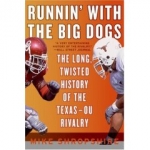
Part of [beating Texas] is that old Okie inferiority complex. There’s no better cure for that than whipping Texas’s butt.
-Barry Switzer, former Oklahoma coach
In 1929 at the height of the Great Depression, the Texas-Oklahoma game was moved to Dallas to coincide with the State Fair of Texas. Back then, it was seen as merely one more attraction to bring people out. By the next year, the Cotton Bowl was built on the same site. That stadium has hosted the Texas-OU game ever since. Lying midway between the two schools, this annual spectacle attracts large crowds from both state schools.
Mike Shropshire gets the story dead on, right from the get go. After quickly giving a little modern context to Oklahoma and Texas’s current football success (both teams are in the top ten as this review is written in the fall of 2007), Shropshire chronicles the event surrounding the game as the Texas and Oklahoma faithful arrive for a weekend of glory or despair. After all, it is the fans that make give this game meaning.
The storyline pretty much stays the same year after year. Texas is usually wearing the white hat, seeming to always play the role of the favored. Oklahoma has the chip on its shoulder. Over the decades of play in this annual rivalry, both teams have had runs of dominance.
Shropshire introduces us to the coaches that defined the game like Oklahoma's Bud Wilkinson, a man of decorum and class originally from Minnesota, as well as Darrell Royal, one of Wilkinson's QBs at Oklahoma who later ended up becoming one of Texas's most revered coaches.
The colorful anti-Wilkinson, Barry Switzer, later leads Oklahoma on a long campaign of national title runs and NCAA violation scrapes. (Shropshire also duly notes that Switzer was orginally from Arkansas another state whose biggest college team has cast a long shadow across college football in Texas.) With Wilkinson coming from the north, Royal from Oklahoma, and Switzer from Arkansas, the whole context of the Texas-Oklahoma game has new meaning for that region of the country. It's more than just a simple border war.
Beyond the coaches, there are several other hilarious player profiles from Joe Don Looney to Earl Campbell to Billy Sims to Marcus DuPree. Some of the players made it to the NFL. Some didn't. Regardless, each is a legend in this rivalry.
Sadly, the spirit of the whole series is in jeopardy.
First, the old moniker for the game, the Red River Shootout, has been changed to "The Red River Rivalry" to make it more politically correct.
Next, the Cotton Bowl venue, an aging facility, is in danger of losing the game. The city of Dallas stepped up and agreed to renovate the stadium to keep it there until 2010, but one wonders how long beyond that. As he notes, "Dallas developers fear and abhor history even more than they do trees because they haven't devised strategies to exploit and cash in on either."
The knowledge of this game's potential departure from the Cotton Bowl site gives a certain poignancy to Shropshire's book. Referencing the idea that Texas and Oklahoma may move the game to a "home and home" format, he writes, "the impact and sense of loss will fall mostly on the Oklahomans, whose fire and zeal provide the catalyst that makes the annual Dallas collison so visceral, so genuine."
Glittz vs. Grit. That about sums it up.
- Jim Markel
Read More...
All tribalfever reviews All reviews All tribalfever articles All tribalfever dispatchesComments
maryhao says...
Couture Wedding Dresses Plus size Wedding Dresses offer distinct design and superior style. Choose from mother of the bride skirt sets Maternity Wedding Dresses What fabric is this dress made Destination Wedding Dresses Blue Wedding Dresses Vintage Wedding Dresses Unique Wedding Dresses Romantic Wedding Dresses Winter Wedding Dresses What color is shown on the model? Is it silver, taupe, gray? It's hard to tell because of the Taffetta material. And will this dress be available for a couple months? Summer Wedding Dresses ordered 4 dresses to be used as bridesmaid dresses in a wedding. I have just received them and they are more beautiful than I imagined. The dresses were made with great skill and craftma Discount Wedding Dresses Simple Wedding Dresses Casual Wedding Dresses Modest Wedding Dresses Bridesmaid Dresses Sexy Bridesmaid Dresses Simple Bridesmaid Dresses Spaghetti Bridesmaid Dresses Strapless Bridesmaid Dresses Junior Bridesmaid Dresses Prom Bridesmaid Dresses Discount Bridesmaid Dresses Flower Girl Dresses Plan calls for things organized, so, in order to obtain better results. Marriage is such an effective plan occasion is necessary. Popular Flower Girl Dresses Spaghetti Flower Girl Dresses Strapless Flower Girl Dresses Baby Flower Girl Dresses Infant Flower Girl Dresses Toddler Flower Girl Dresses These dresses are for girls 3-14 years of age. Please check the "Junior Dress Size Chart" on the left-hand side according to Mother of The Bride Dresses Quality material,amazing dress Simple Mother of The Bride Dresses Elegant Mother of The Bride Dresses Fashion Mother of The Bride Dresses Winter Mother of The Bride Dresses Summer Mother of The Bride Dresses Discount Mother of The Bride Dresses mother of the bride formal gowns, apparel, outfits in Austin, Texas. Discount modest mother of the groom dress in petite Classic Dresses Party Dresses.
kokowowoman says...
A ugg boots clearance recent survey found that one out of five Americans teenage or older want an iPad. No wonder Apple is selling three million iPads a month. It's the fastest-selling single product in the history of consumer electronics. Most buyers are choosing an iPad as a supplement to their current computers -- for watching movies in bed, like I do, or reading books in my easy chair when there's nothing good on TV ugg boots clearance. The iPad pretty much has the personal side of computing covered. But what about the computer side? What about the tasks you do on your laptop or on your desktop computer ugg boots clearance? But I'm convinced that many of you would find the iPad a delightful replacement for a typical laptop computer, whether a Windows PC or Mac, if you mostly use a laptop for three typical functions -- e-mail, social networking (through Facebook, for example) and Web browsing ugg boots clearance. What about occasional word processing? Apple's word processor, called Pages, is outstanding on the iPad. (A bonus: It also works easily with Microsoft Word documents, both reading them and saving them.) If you need software that can show and create PowerPoint presentations, iPad software called Keynote can do that nicely. There's even an Excel-compatible program called Numbers ugg boots clearance. All three of these productivity programs -- called apps -- sell for only $10 each. Getting something equivalent to Microsoft Office for only $30 is surely a steal ugg boots clearance. There are many, either free or a couple of dollars, at the App Store ugg boots outlet. Could an iPad be your only computer? Not for long. It gets updates via free software called iTunes running on a standard computer. When you plug the iPad into the computer using a USB cable, iTunes transfers the updates to your iPad ugg boots outlet. (iTunes is also used to add music, books, podcasts, university lectures, TV shows and movies to an iPad.) But if my experience is a guide, the iPad can function well as a replacement for a laptop. If you buy one, be sure to get the Keyboard Dock and the Camera Connection Kit. Photos look spectacular on the 10-inch screen ugg boots clearance.
Please login or you can
If you aren't registered, Register Now to start leaving comments.