






The Prince of Frogtown
by: Rick Bragg
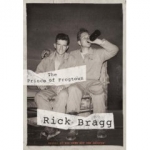
“My father was the prince of Frogtown” writes Alabama author and Pulitzer Prize winner Rick Bragg in his latest book entitled The Prince of Frogtown. In this brutally honest, gut wrenching, and heartrending story, Bragg attempts, once again, to come to terms with his long-dead alcoholic and abusive father while at the same time learning to become a father himself. In 2005 at the age of 46, Bragg found himself married and the step-father of a ten year old boy. He writes that a man who chases a woman with a child is “like a dog that chases a car and wins.”
Each of the seventeen chapters of the book alternates between the past—his father’s coming of age in the mill village (the place they call Frogtown) in Jacksonville, Alabama—and the present—his own coming of age as a parent to a child who is all but an alien to him. “I had read of boys in plastic bubbles ho had more adventure.”
Much as Stephen Daedalus wandered the labyrinthine streets of Dublin in quest of a father, Bragg journeys in his imagination back to the hardscrabble Jacksonville of his father’s youth and even his grandfather’s youth to search for the father he had never really known. “ Man, I wish I could have known him. They say he was slick and pretty in ’55…” are the opening lines of Chapter One. These words set the tone for the rest of the book—the piecing together of the life of a father who abandoned his family for alcohol and who never was reclaimed. “It was that year I realized…,” Bragg writes, “that the devil lives in Alabama and swims in a mason jar.”
Bit by bit, Bragg stitches together the patchwork quilt of his father’s life from stories told by friends and family and what little he himself can remember. He struggles to answer the questions of what happens to a man when he is no longer a man and where to place the blame—on the dehumanizing life in a mill town where the mill claimed pieces of men as well as the lives of women and children, where a man was destined to failure before he was even born or on the power of moonshine whiskey to poison the very wellspring of life itself or on weakness of character, a lack of moral fiber. The questions are never really answered, but what emerges is the complex portrait of a man, his dreams, and his ultimate ruination.
Inserted inside each chapter, like the filling in a cake, is the story of “the boy” as Bragg calls the stepson he inherited when he married his mother . In these episodes we watch Bragg as he struggles with his own rebellious nature and his utter lack of ability to parent a ten year old boy. Having had no role model and fearing the boy will not be tough enough to survive in the real world, Bragg blunders through the boy’s pre-adolescent years, learning the lessons he never learned as a boy himself and eventually understanding that gentleness can travel hand in hand with strength. Just as the story of his own father was one of humiliation and defeat, the story of the boy is one of triumph and exultation. “The boy” becomes “my boy” as Bragg moves closer and closer to becoming the father he so desperately wanted and never ever had.
No one tells a story better than Rick Bragg and few writers are so unflinchingly candid in their recollections and observations. These are the qualities that made Bragg not only a prize winning journalist but also catapulted his first two memoirs All Over But the Shoutin’ (a paean to his mother) and Ava’s Man (a tribute to his maternal grandfather) to the top of the New York Times best seller list. In The Prince of Frogtown, Bragg writes “With this book I close the circle of family stories in which my father occupied only a few pages, but lived between every line.” At long last ,Bragg has found his father and at the same time discovered the father in himself.
---Penne J. Laubenthal
-
Comments
kokowowoman says...
A ugg boots clearance recent survey found that one out of five Americans teenage or older want an iPad. No wonder Apple is selling three million iPads a month. It's the fastest-selling single product in the history of consumer electronics. Most buyers are choosing an iPad as a supplement to their current computers -- for watching movies in bed, like I do, or reading books in my easy chair when there's nothing good on TV ugg boots clearance. The iPad pretty much has the personal side of computing covered. But what about the computer side? What about the tasks you do on your laptop or on your desktop computer ugg boots clearance? But I'm convinced that many of you would find the iPad a delightful replacement for a typical laptop computer, whether a Windows PC or Mac, if you mostly use a laptop for three typical functions -- e-mail, social networking (through Facebook, for example) and Web browsing ugg boots clearance. What about occasional word processing? Apple's word processor, called Pages, is outstanding on the iPad. (A bonus: It also works easily with Microsoft Word documents, both reading them and saving them.) If you need software that can show and create PowerPoint presentations, iPad software called Keynote can do that nicely. There's even an Excel-compatible program called Numbers ugg boots clearance. All three of these productivity programs -- called apps -- sell for only $10 each. Getting something equivalent to Microsoft Office for only $30 is surely a steal ugg boots clearance. There are many, either free or a couple of dollars, at the App Store ugg boots outlet. Could an iPad be your only computer? Not for long. It gets updates via free software called iTunes running on a standard computer. When you plug the iPad into the computer using a USB cable, iTunes transfers the updates to your iPad ugg boots outlet. (iTunes is also used to add music, books, podcasts, university lectures, TV shows and movies to an iPad.) But if my experience is a guide, the iPad can function well as a replacement for a laptop. If you buy one, be sure to get the Keyboard Dock and the Camera Connection Kit. Photos look spectacular on the 10-inch screen ugg boots clearance.
Please login or you can
If you aren't registered, Register Now to start leaving comments.